
Why Housing Affordability Keeps Worsening in Australia
- ZENG Research Institute

- Jul 2
- 8 min read
Updated: Jul 3
Australia’s housing affordability problem is often discussed as if it were caused by one simple factor: migration, investors, planning rules, interest rates, or construction costs. Each of these matters. But none of them alone explains why affordability keeps worsening across different cities, tenures, and income groups.
A more useful way to understand the problem is to see housing affordability as a system failure. Demand has grown faster than the housing system can respond. New homes take years to plan, approve, finance, service, build and connect to infrastructure. Land that is technically available is not always well located or ready for development. Infrastructure investment often lags population growth. And as households move further from job-rich areas in search of cheaper housing, they face higher commuting costs, longer travel times and reduced access to opportunity.
This article explains why affordability keeps deteriorating in Australia through six connected factors: population growth, construction cycles, land supply, infrastructure, commuting costs and spatial structure.
1. Population growth creates immediate housing demand
Population growth is not the only cause of housing pressure, but it is one of the clearest demand-side forces. When the population grows, new
households need somewhere to live immediately. Students, skilled migrants, temporary workers and returning Australians all enter the rental market or share housing before eventually moving through the broader housing system.
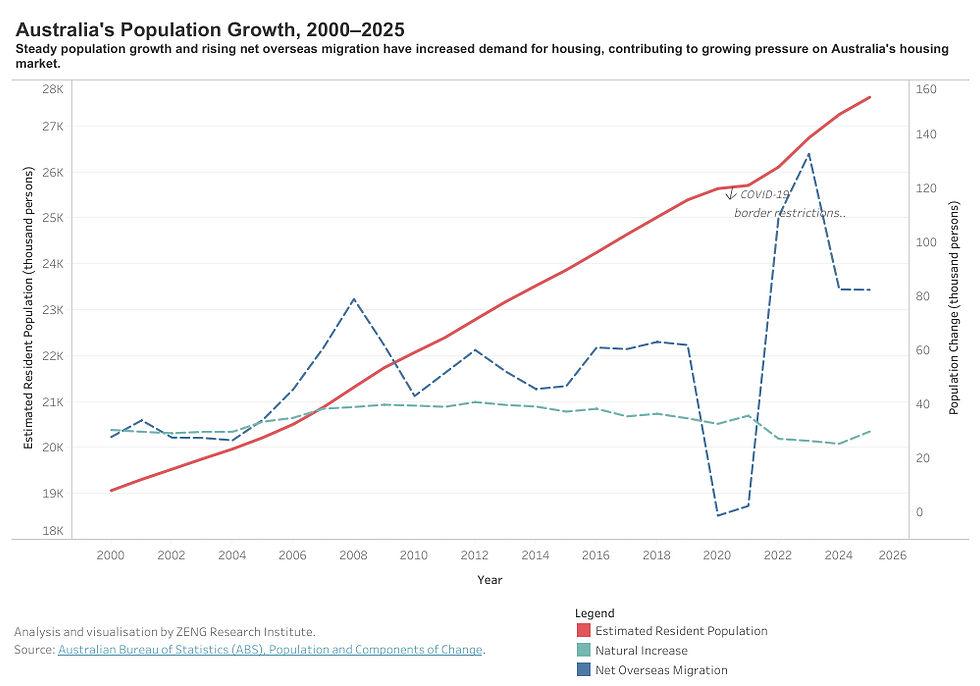
Australia’s recent population growth has been strongly influenced by net overseas migration. This does not mean migration is “the problem”. Migration supports universities, health care, construction, hospitality, technology, regional labour markets and long-term economic growth. But housing demand created by population growth arrives quickly, while housing supply responds slowly.
This timing mismatch is central. A migrant household can arrive this month, but a new apartment building may take several years from site identification to completion. Even detached housing on greenfield land requires planning, subdivision, roads, utilities, finance, labour and materials. When demand rises faster than supply can adjust, prices and rents increase.
The key policy issue is therefore not whether population growth is good or bad. It is whether housing, infrastructure and planning systems are coordinated with realistic population scenarios. A country that relies on migration for economic and demographic reasons must also build the homes, transport networks and services needed to absorb that growth.
2. The construction cycle is too slow and too fragile
Housing supply is often discussed as if governments can simply “build more homes”. In reality, the construction pipeline is long and exposed to multiple risks.
A dwelling must pass through several stages: land assembly, planning approval, design, finance, pre-sales, infrastructure servicing, construction and final completion. Apartments can be especially sensitive to interest rates, construction costs, builder capacity and market confidence. Even when approvals increase, completions may not rise quickly if projects are delayed or become financially unviable.
Australia’s construction sector has also struggled with productivity. If construction productivity is weak, then labour, materials and capital produce fewer homes than they otherwise could. This means that even when demand is strong and governments set ambitious housing targets, the industry may not have enough capacity to deliver at the required speed.
This matters for affordability because slow supply response allows shortages to persist. In a responsive housing system, rising demand would trigger faster construction and more diverse housing options. In Australia, the response is often delayed. The result is a repeated cycle: demand increases, rents rise, prices rise, political pressure builds, reforms are announced, and then the physical supply response arrives years later — often after affordability has already worsened.
3. Land supply is not just about quantity
Australia is a large country, so it may seem strange to talk about land scarcity. But housing affordability is not determined by total land area. It is determined by access to well-located, developable and serviced land.
Land must be in the right place, with access to jobs, schools, transport, health services, utilities and community infrastructure. Land must also be legally and physically ready for housing. A block on the urban fringe is not truly housing supply if it lacks roads, sewerage, public transport, schools or realistic access to employment centres.
This is why the distinction between “land supply” and “effective land supply” is important. A city may have greenfield land at the edge, but if that land is far from jobs and infrastructure, it does not fully solve affordability. It may lower the purchase price of the dwelling, but increase transport costs, time costs and public infrastructure costs.
In established suburbs, the challenge is different. Many well-located areas have strong access to jobs and services but restrict medium-density housing. This limits the number of households who can live close to opportunity. When high-access locations are reserved mainly for low-
density housing, scarcity is built into the spatial structure of the city.

4. Infrastructure turns land into usable housing
Housing cannot be separated from infrastructure. Roads, public transport, water, sewerage, electricity, schools, health services and open space determine whether new housing is liveable and connected.
Infrastructure delays can slow housing delivery even when planning rules allow growth. Developers may wait for trunk infrastructure. Councils may be reluctant to approve new housing if local services are already under pressure. Residents may oppose higher density if transport, parking, schools or health services are not upgraded. In this way, infrastructure constraints become housing constraints.
The reverse is also true. Well-planned infrastructure can unlock housing supply. A new rail station, bus corridor or town centre can make higher-density housing more viable and politically acceptable. But this requires coordination across levels of government. Housing policy, transport policy and infrastructure funding cannot operate in separate silos.
An evidence-informed housing strategy should therefore ask not only “how many homes?” but also “where, connected to what, and for whom?” A housing target without infrastructure planning risks producing either delayed supply or poorly located supply.
5. Commuting costs are part of housing affordability
Housing affordability is usually measured through rents, mortgage repayments or house prices relative to income. These measures are useful, but they can understate the true cost of living in different locations.
A cheaper home far from employment may not be genuinely affordable if it requires long commutes, high car dependence, fuel costs, parking costs and lost time. For many households, the trade-off is not simply between cheap and expensive housing. It is between housing cost and transport cost.
This is particularly important in Australian cities, where employment is often concentrated in central areas and major activity centres, while more affordable housing is pushed outward. Lower-income households may be forced to accept longer commutes to access cheaper housing. This can reduce time with family, limit job choices, increase stress and make daily life more expensive.
Relationship between weekly rent and commuting cost across SA2s in Sydney

The figure above illustrates one important mechanism behind Australia's housing affordability challenge: lower housing costs are frequently offset by higher commuting costs.
From a policy perspective, this means housing affordability should be assessed alongside accessibility. A well-located apartment near public transport and jobs may provide better real affordability than a cheaper detached house on the fringe with high commuting costs. Similarly, improving transport access to affordable areas can improve effective affordability even without reducing house prices directly.
6. Spatial structure shapes who gets access to opportunity
Australia’s housing affordability problem is also a spatial problem. The location of housing relative to employment, education, health care and transport determines whether households can access opportunity.
When high-income households occupy the most accessible areas and lower-income households are pushed to less connected areas, housing markets reinforce inequality. People are not only priced out of homes; they are priced out of access.
This is why housing supply in well-located areas matters. Adding more homes only at the urban fringe can increase dwelling numbers, but it may not solve access inequality. A more balanced approach requires both greenfield and infill development: new communities on serviced land, and more medium-density and apartment housing in established areas with strong access to jobs and services.
Spatial structure also affects productivity. If workers cannot live near suitable jobs, labour markets become less efficient. Employers face recruitment difficulties. Workers spend more time commuting. Cities become larger but not necessarily more productive. In this sense, housing affordability is not only a social issue; it is an economic development issue.
What should policy focus on?
The evidence suggests that Australia's housing affordability challenge cannot be solved through a single policy intervention. Public debate often focuses on individual solutions—such as increasing migration caps, expanding first-home buyer grants, accelerating planning approvals or releasing more land. While each of these measures may contribute to improving affordability under certain circumstances, none is sufficient on its own because the housing system is shaped by multiple interconnected factors.
Demand-side policies, such as first-home buyer grants, shared equity schemes or deposit assistance, may improve access to home ownership for some households. However, if housing supply remains constrained, these policies can unintentionally increase purchasing power without increasing the number of available homes, placing further upward pressure on prices. Likewise, simply increasing housing supply without considering transport accessibility, employment locations and supporting infrastructure may result in new housing that is affordable in price but costly in terms of commuting time and access to opportunities.
A more effective and durable response requires improving the overall responsiveness of Australia's housing system. This means ensuring that housing supply can respond more quickly and more efficiently to changing population needs, while also improving the quality and location of new development. In practice, this requires coordinated action across multiple policy areas, including:
aligning population growth with long-term housing and infrastructure planning;
improving construction productivity, workforce capacity and supply chain resilience;
reducing unnecessary delays in planning approvals while maintaining appropriate environmental and community standards;
ensuring a greater supply of developable, serviced and well-located land;
encouraging more diverse housing types, including medium-density housing in established suburbs with good access to employment and services;
coordinating transport investment, utilities and social infrastructure alongside new housing development;
expanding social and affordable housing for households that cannot be adequately served by the private market; and
evaluating housing affordability not only through housing costs, but also through accessibility to jobs, education, healthcare and other essential services.
Importantly, affordability should be viewed as an outcome of the entire urban system rather than the housing market alone. Housing, transport, infrastructure and land-use planning are deeply interconnected. Decisions made in one sector inevitably affect outcomes in another. For example, transport investments can unlock new housing opportunities, while planning reforms without supporting infrastructure may have only limited effects. Similarly, housing development on poorly connected urban fringes may increase dwelling numbers but do little to improve overall affordability once transport costs and travel time are taken into account.
This broader perspective also highlights the importance of spatial planning. Housing policy should not only aim to increase the total number of dwellings, but also improve the spatial distribution of housing relative to employment centres, public transport, education, healthcare and other essential services. Well-located housing creates broader economic and social benefits by reducing congestion, improving labour market accessibility, increasing productivity and enhancing quality of life.
The deeper lesson is that housing affordability is not simply about building more dwellings in aggregate. It is about building the right homes, in the right places, at the right time, supported by the right infrastructure and connected to opportunities. Success should therefore be measured not only by the number of homes delivered, but also by whether those homes enable people to live, work and participate fully in their communities.
Australia's housing affordability challenge has developed over many years and is unlikely to be resolved quickly. Demand can increase rapidly through population growth and changing household formation, while housing supply, infrastructure delivery and urban development typically require many years to respond. Unless governments address these structural timing mismatches and improve coordination across housing, infrastructure and planning systems, affordability pressures are likely to persist even if individual reforms appear successful in isolation.
Ultimately, housing policy is where population policy, infrastructure policy, transport policy, planning policy and economic development policy converge. Treating housing affordability as a single-sector issue has repeatedly produced fragmented and short-lived solutions. An evidence-informed approach requires governments to recognise housing as a complex system, understand the interactions between its different components, and design policies that improve the performance of the system as a whole rather than addressing symptoms in isolation.
Looking Ahead
Australia's housing affordability debate is often driven by short-term political cycles, yet the underlying challenges are structural and long-term. Building a more affordable housing system will require sustained investment, coordinated governance and evidence-informed decision-making across multiple policy domains. Future Insights from ZENG Research Institute will further examine how accessibility, transport, regional development and spatial planning can contribute to more affordable, equitable and liveable Australian cities.


Comments